
Buying and selling land in Vietnam is one of the most common property transactions for both individuals and organizations. Whether you are purchasing a home, acquiring agricultural land, or transferring property for business purposes, the legal process of land title transfer is critical. Without following the proper procedures, your transaction may not be recognized by authorities, exposing you to financial and legal risks.
This article provides a detailed overview of the land title transfer Vietnam process, including step-by-step guidance, required documents, costs, timelines, and common mistakes to avoid. It reflects the most recent legal updates for 2025, helping buyers and sellers navigate the system effectively.
What Is Land Title Transfer in Vietnam?
In Vietnam, land is owned by the State. Individuals and organizations cannot own land outright but are granted land use rights. The Red Book, officially known as the Certificate of Land Use Rights, House Ownership, and Other Assets Attached to the Land, is the legal proof of these rights.
Land title transfer, therefore, means the legal transfer of land use rights from one party to another. This process must be recognized by government authorities through notarization, tax clearance, and official registration. Once the transfer is completed, the buyer’s name will be updated on the Red Book, making them the legal land user.
Who Can Transfer and Receive Land Use Rights?
Vietnamese citizens with valid Red Books may transfer land use rights to other individuals or organizations. Foreigners, however, cannot directly own residential land. They can only acquire land use rights through foreign-invested enterprises or by purchasing apartments in eligible developments under separate regulations.
Organizations, including companies and cooperatives, may transfer land use rights provided that the land is used in accordance with its designated purpose. For example, agricultural land cannot be sold for housing development without conversion approval.
Step-by-Step Process of Land Title Transfer in Vietnam
The land title transfer Vietnam process typically involves the following steps:
Step 1: Verify Legal Status of the Land
Before signing any contract, the buyer should verify that the land has a valid Red Book, is not under dispute, and is eligible for transfer. This verification can be done at the local Land Registration Office or through a professional legal service provider. Checking whether the land has unpaid taxes, encumbrances, or zoning restrictions is crucial.
Step 2: Negotiate and Draft the Transfer Contract
Once verification is complete, the buyer and seller must negotiate terms and prepare a transfer contract. This contract must be in writing and include details such as land location, area, price, payment method, and responsibilities of each party.
Step 3: Notarize the Contract
Vietnamese law requires that land transfer contracts be notarized at a licensed notary office. Both parties must be present with their identification documents and the original Red Book. The notary will verify the legality of the transaction and certify the contract. Without notarization, the contract is invalid.
Step 4: Fulfill Tax and Fee Obligations
After notarization, both parties must fulfill their financial obligations. Typically, the seller pays personal income tax (2% of the transaction value), while the buyer pays the registration fee (0.5% of property value). Local regulations may add small administrative fees. Having tax receipts is mandatory for registration.
Step 5: Submit Application for Transfer Registration
The notarized contract, original Red Book, tax receipts, and application form must be submitted to the local Land Registration Office. The dossier will be checked, and if complete, authorities will process the ownership update.
Step 6: Receive Updated Red Book
Once approved, the buyer’s name is entered into the Red Book as the new land user. The updated certificate can then be collected from the Land Registration Office, officially completing the transfer.
Timeline for Land Title Transfer
The official processing time for registration is usually 10 working days. However, the overall process, including notarization and tax clearance, often takes 15–30 days. Complicated cases, such as those involving inheritance, disputes, or land conversion, may extend to several months.
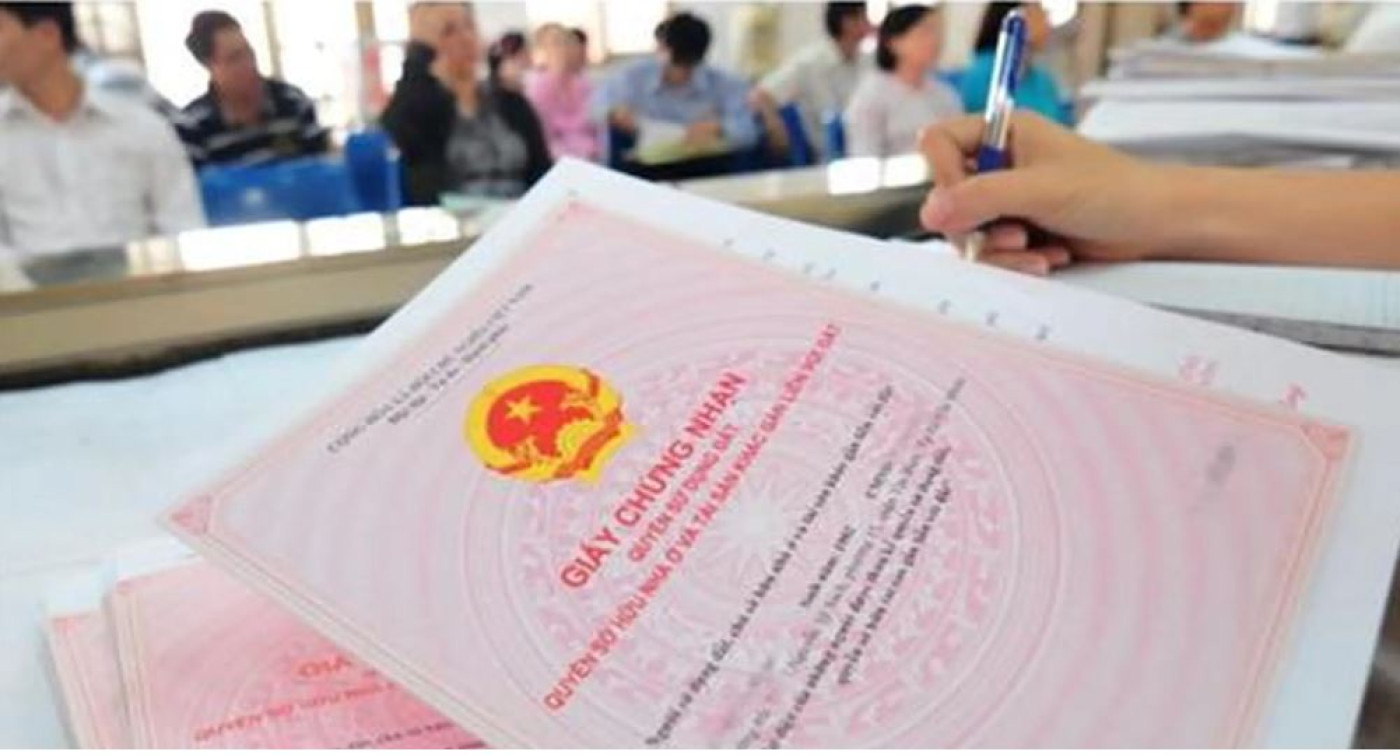
Land title transfer Vietnam process(illustration)
Costs Involved in Land Title Transfer
Applicants must prepare for several types of costs. The seller usually pays personal income tax, equal to 2% of the transfer price or state-assessed value, whichever is higher. The buyer pays the registration fee, typically 0.5% of the property value, along with administrative fees for dossier processing. Notarization fees are based on the contract value, with a progressive rate set by the Ministry of Justice. Additional costs may include cadastral measurement fees if land boundaries require updating.
Common Mistakes to Avoid
Despite clear procedures, many transactions face difficulties due to common errors. Some buyers fail to verify land status, later discovering disputes or zoning restrictions that prevent transfer. Others attempt to transfer land without a valid Red Book, leading to rejection. A frequent mistake is underreporting the transaction price to reduce taxes. Authorities cross-check market values, and discrepancies can result in fines or contract invalidation.
Another error is skipping notarization. Informal agreements or handwritten contracts are not legally binding and cannot be used for registration. Foreign investors often misunderstand restrictions, assuming they can buy land directly. In reality, they must follow specific regulations, such as investing through companies or purchasing eligible apartments.
Case Study: Successful and Failed Transfers
One successful example involves a household in Hanoi selling residential land. By verifying land status in advance, preparing all documents, and fulfilling tax obligations promptly, they completed the transfer within 20 days. The buyer received an updated Red Book without delay.
By contrast, a failed case involved an individual who tried to sell agricultural land for housing without obtaining conversion approval. The notary rejected the contract, and the buyer lost time and money. This highlights the importance of ensuring that land use matches the intended purpose before transfer.
Updated Legal Framework for Land Title Transfer in Vietnam (2024–2025)
Vietnam has continuously updated its land regulations to make property transactions more transparent and efficient. Under the latest amendments to the Land Law and related decrees, land users are now subject to stricter verification requirements before transfer is approved. This includes digital records, land database checks, and more rigorous tax assessments. Authorities also emphasize electronic submission of documents, reducing the reliance on paper dossiers. By 2025, many provinces are piloting online portals where transfer applications can be tracked in real time. This helps reduce delays caused by missing paperwork or human errors. Another important update is the increased penalty for tax evasion during land transfers. Buyers and sellers who intentionally declare a transaction price much lower than the market value to reduce tax obligations may face additional fines, back taxes, and in some cases, invalidation of the contract. Foreign investors should also note that although the Land Law still restricts direct land ownership, the new Investment Law provides clearer guidance on how foreign-invested companies can lease land for up to 50 years, renewable depending on project approval.

Land title transfer Vietnam process(illustration)
Detailed Document Checklist for Land Title Transfer
Both buyers and sellers must prepare comprehensive documentation to ensure smooth processing. The seller must provide the original Red Book, personal identification (ID card or passport), marriage certificate if applicable, and tax identification number. If the land is jointly owned by spouses, both must consent to the transfer. The buyer must prepare identification documents, proof of residence, and tax identification number as well. The notarization stage requires both parties to present these documents, together with the drafted contract. For registration at the Land Registration Office, additional paperwork is required: the notarized contract, original Red Book, completed application form (as per Ministry of Natural Resources and Environment guidelines), tax payment receipts, and cadastral maps if land boundaries have been updated. If the land is inherited or donated, further documents such as wills, inheritance declarations, or donation agreements are necessary. Preparing a complete dossier from the beginning prevents rejection and saves significant time.
Practical Timeline and What Delays It
Although the official timeline is set at ten working days, in reality, delays frequently occur. One of the main causes is incomplete documentation. Missing a marriage certificate, for example, can postpone notarization. Another reason is tax clearance delays, especially if the seller has outstanding debts with local tax authorities. Boundary disputes or inconsistencies in cadastral maps may require re-measurement, which adds weeks. Public holidays and administrative workload also impact processing time. On the other hand, engaging professional legal services helps minimize delays. Lawyers can pre-check dossiers, ensure tax declarations are accurate, and liaise with authorities on behalf of clients. In practice, a smooth transfer may still take 20–30 days, but without professional guidance, it can extend to several months.
Key Differences Between Urban and Rural Land Transfers
The process is broadly similar across Vietnam, but there are important distinctions between urban and rural areas. Urban land usually has more accurate cadastral maps and higher market value, which means authorities scrutinize transactions closely. Rural land, especially agricultural land, often faces stricter restrictions on conversion and usage. For example, farmland cannot be freely transferred for residential purposes without official approval to change its designated use. Additionally, rural areas may have weaker enforcement of land boundaries, leading to more disputes over size and ownership. Buyers must be particularly cautious when acquiring rural land, ensuring that the actual plot matches the Red Book description. For investors, urban land transfers are generally faster but more expensive, while rural transfers may appear cheaper but carry higher legal risks.
Lessons from Past Violations
Authorities have reported several recurring violations in land title transfers. A frequent issue is the use of fake or altered Red Books. Criminal cases have been recorded where buyers unknowingly purchased land with counterfeit certificates. This underscores the importance of verifying documents directly with the Land Registration Office rather than relying solely on sellers. Another violation is the illegal subdivision of land. Some landowners split a plot into smaller parcels without approval and sell them individually. These transfers are not legally recognized, leaving buyers without valid land use rights. There are also cases of investors acquiring agricultural land and illegally constructing housing projects without conversion approval. The government has since tightened inspections, and buyers in such projects often face the risk of losing both property and money. By learning from these violations, buyers and sellers can better understand the risks and follow the correct process to ensure their transaction is valid.
Frequently Asked Questions about Land Title Transfer
1. How long does it take to complete a land title transfer in Vietnam? On average, it takes 15–30 days, depending on document readiness, tax clearance, and local administrative efficiency. Complicated cases may take longer.
2. Can foreigners buy land in Vietnam? No, foreigners cannot directly own land but can own apartments in eligible developments. They may also invest through foreign-owned companies that lease land for projects.
3. Who pays taxes during a land transfer? Generally, the seller pays personal income tax (2% of transfer value), while the buyer pays the registration fee (0.5%). However, parties can negotiate differently if agreed in the contract.
4. Do I need a lawyer to transfer land? Legally, no. However, engaging a lawyer ensures compliance, prevents mistakes, and speeds up processing, especially for foreign investors or large transactions.
5. What happens if the land is under dispute? Authorities will not process the transfer until the dispute is resolved. Buyers should always verify the dispute status before signing.
6. What if the Red Book lists both husband and wife as owners? Both spouses must consent to the transfer. If one is absent, power of attorney documents must be notarized and submitted.
7. Are online applications available? In some provinces, yes. Online portals are being piloted, allowing submission and tracking. However, notarization still requires in-person presence.
8. What happens if I underreport the transaction price to reduce tax? This is illegal. Authorities cross-check market values, and if discrepancies are found, penalties and back taxes apply.
Advanced FAQs and Special Situations
Beyond the common questions, there are many advanced scenarios where buyers and sellers encounter unique challenges. For instance, what happens if the land was inherited but not yet updated in the Red Book? In this case, heirs must complete the inheritance registration before transferring to a third party. This adds one more step, often requiring court recognition or notarized inheritance declarations. Another frequent issue arises when land belongs to a minor. The transfer requires approval from guardians and sometimes court validation to ensure the minor’s rights are protected. A further complication occurs when land is pledged as collateral for bank loans. Transfer is impossible until the mortgage is released and the bank provides official confirmation.
Some buyers also ask whether land can be transferred during an ongoing zoning project. The answer is yes, but with caution. If the land is designated for future public works such as roads or parks, compensation rules will apply, and the buyer may not be able to use the land as intended. Finally, for joint ventures or co-ownership, each co-owner must sign off on the transfer. If one refuses, the process cannot proceed. These advanced cases highlight why professional legal support is highly recommended for non-standard transfers.
Case Studies: Lessons from Practice
To better understand how the land title transfer Vietnam process works in practice, it helps to examine real-life examples.
In one case, a Vietnamese-American returning to Ho Chi Minh City purchased residential land to build a family home. He ensured that the seller’s Red Book was authentic by conducting a verification at the Land Registration Office. By hiring a lawyer to manage tax declarations, notarization, and application submission, he completed the process in just under three weeks. The updated Red Book listed him as the lawful land user, and the transaction was seamless.
By contrast, another buyer attempted to save costs by drafting a handwritten agreement with the seller without notarization. Months later, when applying for registration, the Land Registration Office rejected the application, citing the lack of a valid notarized contract. The buyer had already paid in full but could not register ownership, resulting in a lengthy dispute.
Another example involves a foreign-invested company in Da Nang that sought to purchase industrial land for a factory. They misunderstood the law, believing they could acquire ownership. Instead, they had to lease land through the State, with a maximum term of fifty years. After correcting their approach and amending the application, they secured a long-term lease and successfully launched their project. These case studies demonstrate how both success and failure hinge on understanding legal requirements and following the proper process.
Key Risks and How to Mitigate Them
Every land transfer carries risks, but most can be managed with careful planning. Document fraud remains a top concern. Buyers should always verify the Red Book through official channels and check for existing mortgages or disputes. Zoning changes are another risk, especially in fast-developing cities. Consulting with local authorities about future land use plans before purchase is essential. Tax underreporting is tempting but dangerous; buyers should resist sellers’ proposals to declare lower prices. Penalties can erase any savings and damage credibility.
For foreigners, the biggest risk is misunderstanding ownership restrictions. Only apartments in approved projects are available for direct purchase. All other land acquisitions must go through legally recognized structures, such as foreign-invested enterprises. Mitigating this risk requires professional guidance and clear contractual drafting. In short, risk management is about verifying documents, complying with tax laws, and obtaining legal advice.
Tips for Foreign Investors
Foreign investors often face the steepest learning curve when it comes to the land title transfer Vietnam process. First, they should distinguish between apartment ownership and land use rights. Foreign individuals can buy apartments but cannot buy land. However, foreign-owned companies can lease land for business projects. This structure is commonly used in industrial parks, tourism developments, and agricultural ventures.
Second, investors should plan for lease terms. The maximum is usually fifty years, but extensions are possible depending on government approval. Third, choosing the right location is critical. Industrial zones managed by provincial authorities often provide clearer legal frameworks and faster approval than privately held land. Fourth, investors must consider exit strategies. When selling or transferring leased land, the process requires State approval, which can add months. Finally, engaging bilingual legal services ensures that all contracts, filings, and negotiations are clear in both Vietnamese and English. This prevents misunderstandings that could derail an investment.
Digital Transformation in Land Registration
Vietnam is moving steadily toward digital governance, and land registration is a prime example. Several provinces have already introduced e-government portals where citizens can track their land transfer applications. This reduces the risk of losing documents, eliminates unnecessary trips to government offices, and shortens timelines. The Ministry of Natural Resources and Environment has also announced plans to build a national land database by 2030, integrating cadastral maps, ownership records, and zoning information.
For buyers and sellers, this means that in the near future, verification will be faster and more transparent. Fraudulent Red Books will be easier to detect, and tax records will automatically sync with property transactions. However, until digital systems are fully nationwide, paper-based procedures remain dominant. Parties should be prepared to handle both traditional and electronic processes, depending on the locality.
Emerging Trends in Land Transactions
Several trends are shaping the future of land title transfer in Vietnam. The first is stricter enforcement of tax compliance, as authorities crack down on underreported transactions. The second is greater transparency in zoning plans, with more provinces publishing maps online. This allows buyers to anticipate future development and avoid disputes. The third is the rise of professional legal and notarial services. With land prices soaring, the risks of mistakes are too high, leading more people to rely on expert advisors. Finally, Vietnam’s growing integration into global markets means that foreign investors are playing a larger role, particularly in industrial and commercial land use. These trends point toward a more regulated, transparent, and professional land market.
Why Professional Guidance Matters
While the process may appear straightforward on paper, real-world transactions are rarely simple. A single missing document, misunderstanding of land use classification, or tax miscalculation can cause months of delay. Lawyers and legal consultants add value by conducting due diligence, preparing complete dossiers, ensuring compliance with both national and local regulations, and representing clients at government offices. This is especially important for foreign clients, who often face language barriers and unfamiliar procedures.
Professional guidance also reduces stress. Rather than navigating multiple offices, forms, and tax codes, clients can rely on experts who know exactly how to streamline the process. The small upfront cost of legal support often saves significant time, money, and risk in the long run.
Why Work with Asia Legal Group
At Asia Legal Group, we specialize in guiding clients through the complexities of property law in Vietnam. Our team of experienced lawyers, notaries, and consultants has handled countless land title transfer cases, from simple family transactions to complex foreign-invested projects. We pride ourselves on providing transparent, lawful, and efficient solutions.
For Vietnamese clients, we ensure that every document is accurate, taxes are calculated correctly, and applications are submitted promptly. For foreign clients, we offer bilingual services and strategic advice on how to structure investments legally. Whether you are buying a home, selling land, or acquiring property for business, we protect your interests and ensure compliance with the latest laws.
Our approach is proactive. We do not simply process paperwork; we anticipate risks, resolve complications, and provide clarity at every step. By working with Asia Legal Group, you gain a trusted partner who understands both local practices and international expectations.
Final Thoughts
The land title transfer Vietnam process is a vital step in securing property rights. Although the laws are well defined, practical challenges often arise, from documentation gaps to zoning restrictions. Buyers and sellers who understand the legal framework, prepare complete dossiers, and avoid common mistakes are more likely to succeed. For foreigners, recognizing ownership limitations and structuring investments correctly is essential.
With Vietnam modernizing its land administration and enforcing stricter compliance, the future of property transactions is more transparent and professional. By working with experienced legal advisors such as Asia Legal Group, clients can navigate this evolving landscape with confidence. Whether you are transferring a family home or managing a multi-million-dollar project, success lies in preparation, compliance, and expert guidance.
Source: Asia Legal Group
Phone:: 028 6674 3333 -0945 009002 ( P.TGĐ)
Website: https://dinhgiaav.com/
Address: 6-8 Phan Huy Thực, phường Tân Kiểng, Quận 7, TP.HCM
https://maps.app.goo.gl/Xj2bH7djxmCxJYjv6?g_st=iz
https://www.facebook.com/thamdinhgiachaua
CHECK NEW/OLD COMMUNES 2025 NATIONWIDE, COURT AND PEOPLE'S COMMITTEE ADDRESSES PRELIMINARY LAND VALUATION BY ANY LOCATION NATIONWIDE IN 1 MINUTE

